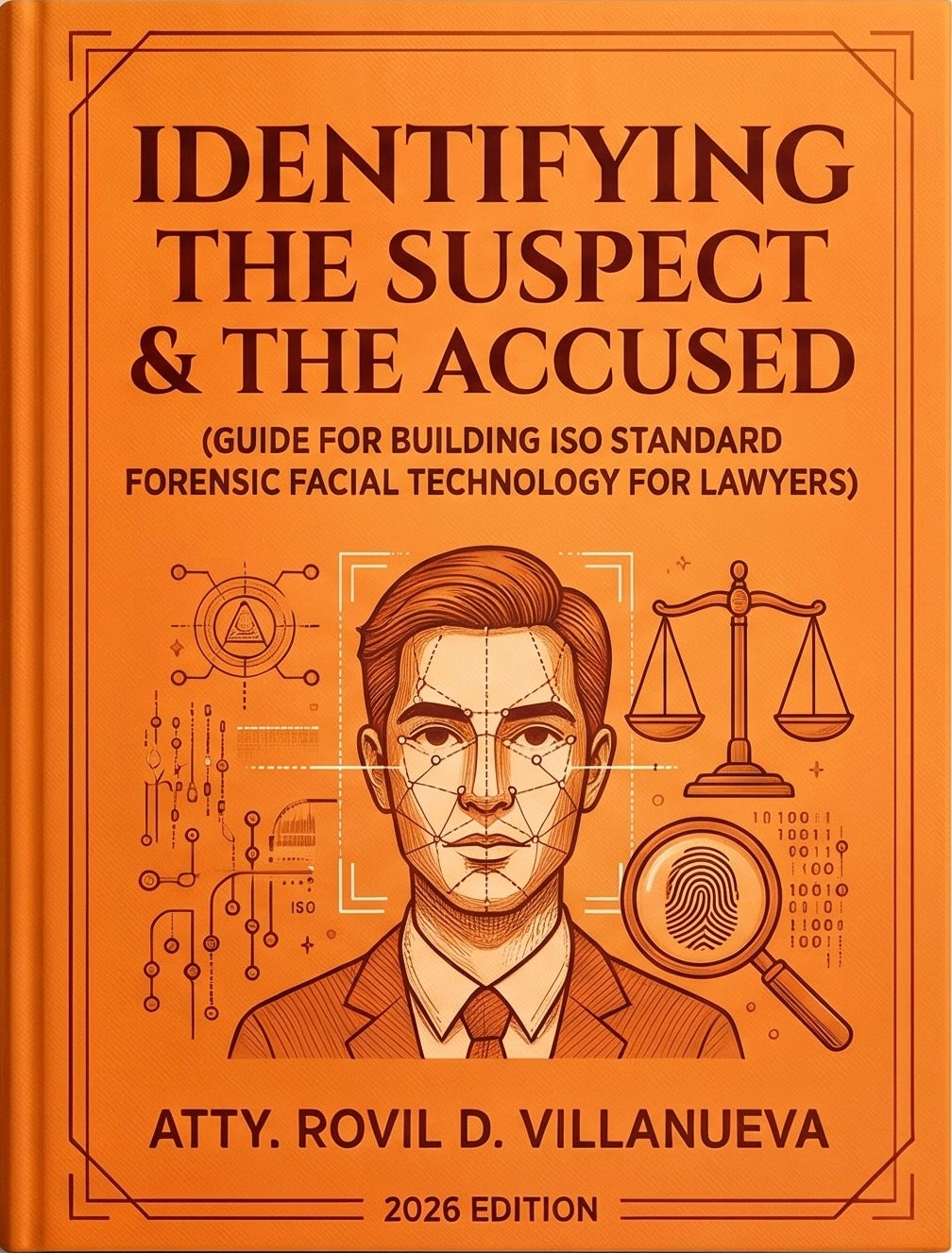
Identifying The Suspect & The Accused (Guide For Building ISO Standard Forensic Facial Technology)
Identifying The Suspect & The Accused (Guide For Building ISO Standard Forensic Facial Technology)
Couldn't load pickup availability
IDENTIFYING THE SUSPECT & THE ACCUSED
Guide For Building ISO Standard Forensic Facial Technology
By Atty. Rovil D. Villanueva — Chief Architect of Forensic Technology, DVM Law Office (Legal Forensic)
In criminal investigation and courtroom litigation, the element of Identity of the perpetrator cannot be left to CCTV footage as the same may be referring to person other than the accused. We need science to defend the innocent. We are servants of Justice.
Every day, criminal prosecutions, security audits, and courtroom trials hinge on low-resolution CCTV clips and mobile captures. Yet far too often, visual identification relies on unverified human impressionism—a quick glance and an unchallenged assertion: "That is the suspect."
Whether you are a defense attorney challenging weak identification evidence, a prosecutor or criminal investigator building an airtight case, or a criminologist, paralegal, law student, or security professional auditing surveillance footage, relying on naked-eye guesses puts justice—and professional credibility—at risk.
IDENTIFYING THE SUSPECT & THE ACCUSED bridges the gap between modern computer vision and courtroom rules of evidence. Written in clear, accessible English without intimidating tech jargon, this practical manual shows you step-by-step how to build and operate your own ISO-standard Forensic Facial Comparison Platform using enterprise cloud APIs and no-code tools.
What You Will Learn Inside This Guide:
-
Build Your Own Forensic Platform (No Coding Required): Learn how to build a personalized computer software (others call it App) using No-Code App Builder, and secure the ISO Standard specialized key (also used by FBI) that uses Computer Vision (like Ultra Sound and Robotics) and connect the said key to your self-built software to run it in your mobile device or laptop.
-
Meet International ISO & Forensic Standards: Enforce strict scientific and evidentiary compliance using ISO/IEC 27037 (digital evidence preservation), ISO/IEC 19794-5 (spatial resolution and Interpupillary Distance thresholds), ISO/IEC 30107 (deepfake and spoofing detection), and the 19-Category FISWG Morphological Comparison Workbench.
-
Preserve Digital Chain of Custody: Protect your visual exhibits from tampering allegations using client-side SHA-256 cryptographic hashing, Write-Once-Read-Many (WORM) storage protocols, and multi-camera timeline reconstruction.
-
Spot Tampered Media & AI Hallucinations: Detect deepfakes, pixel splicing, and unauthorized generative AI upscaling before an exhibit ever reaches the courtroom.
-
Win in Court with Ready-to-Use Legal Templates: Includes a complete, courtroom-ready Philippine Judicial Affidavit Template (compliant with the Rules on Electronic Evidence and 2019 Revised Rules on Evidence) and a 5-Point Cross-Examination Playbook to dismantle unscientific facial identification testimony.
This Book Is a Must-Read For:
-
Trial Lawyers & Defense Counsel: Audit prosecution CCTV timelines, expose confirmation bias, and establish reasonable doubt with demonstrable visual proof.
-
Law Enforcement Officers & Criminal Investigators: Standardize your facial verification workflow so your investigative findings withstand aggressive defense scrutiny.
-
Criminologists & Forensic Examiners: Master the blind 19-point FISWG morphological evaluation and ACE-V discipline.
-
Paralegals, Law Students & Security Personnel: Gain practical, modern legal-tech skills in digital evidence preservation and biometric triage.
Product Specifications:
-
Author: Atty. Rovil D. Villanueva (Managing Lawyer, DVM Law Office – Legal Forensic)
-
Edition: 2026 Edition
-
Format: Digital eBook (Instant Download)
-
Language: English